Small garden, big harvest: surprising success with corn
Last summer the Napa County Master Gardeners field-testing group agreed to try growing corn. I think I must have missed the meeting when this was decided as I have avoided growing corn for many years.
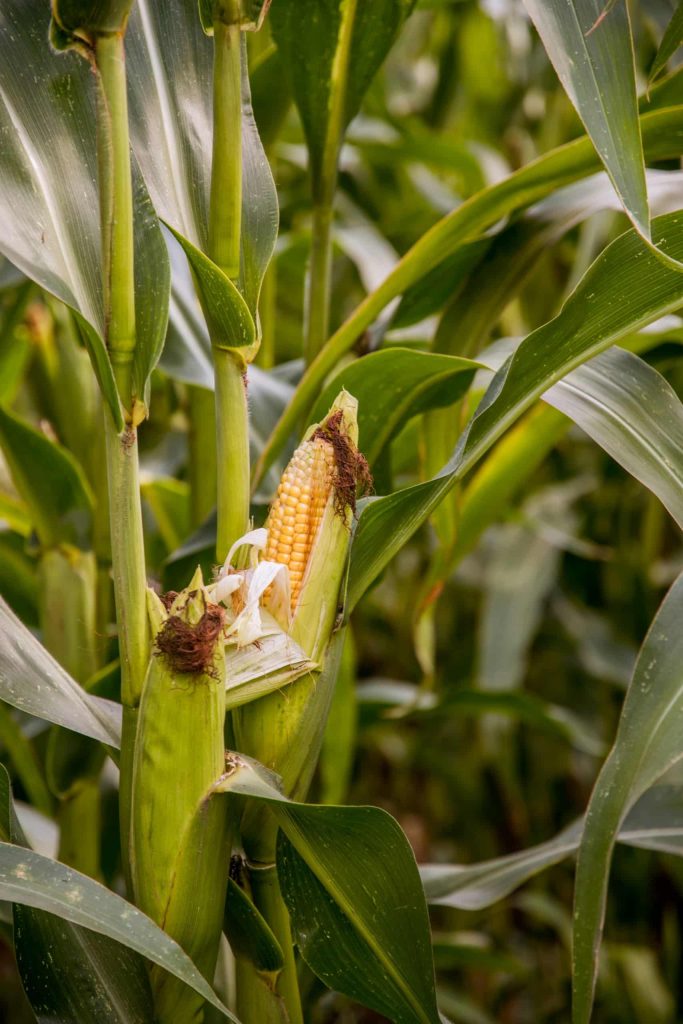
In my view, corn takes too much space for a small garden. Because it is wind pollinated, it needs to be planted in blocks rather than in a single row or two. The stalks grow relatively tall and can shade nearby plants. They like more than the average amount of nitrogen-rich fertilizer, and they need plenty of water.
If you want to grow more than one variety, you need to make sure they don’t cross pollinate by staggering the planting dates so that their flowering periods don’t overlap. Add to this the fact that a block ripens pretty much all at once, resulting in too much corn ready to eat at the same time. To me, corn seemed like too much trouble.
Mindful of the growing and space requirements, our group decided that each tester should grow one variety rather all of us growing all three of the varieties we were comparing. The choices were Blue Jade Dwarf, an heirloom and open-pollinated type; Vision, a hybrid corn with supersweet (sh2) genes; and Temptress, a synergistic hybrid with genetics from sugar-enhanced and supersweet varieties.
Heirloom varieties taste best when cooked immediately after picking, as the sugars in the kernels convert rapidly to starch. The sugar-enhanced and supersweet varieties convert their sugar much more slowly. Most of the corn available in grocery stores today is some version of these modern hybrids.
I received seeds for Temptress and planted them last July, when I had space available in the garden. My vegetable beds are only three feet wide, so I planted three rows of seven seeds each. Only six of the seeds sprouted, possibly due to my not watering the seedbed enough. The plants were strong and healthy, so I decided to persist. In the empty, shaded spots where the seeds didn’t sprout, I tucked in some lettuce seedlings, figuring in midsummer at least the lettuce would grow.
The corn eventually grew taller than I am and nicely shaded the lettuce. Then the tops tasseled, meaning the male flowers were ripening pollen for the wind to distribute onto “silks” coming out of joints in the stalks. In the right sunlight I could even see the fine, nearly invisible yellow dust sift out of the tassels when a breeze blew through.
I wondered if there was a way to help the pollen get to the female flowers, each silk a strand leading to a potential corn kernel. I did some research and discovered that gardeners growing corn in small spaces or even in pots have dealt with this problem in creative ways.
One grower shakes the stalks to get the pollen down to the silks. Another puts a piece of paper under the tassels and shakes the pollen onto the paper and then onto the silks. Yet another cut the tassels off the top of the plant and then swished them all over the silks. All sources agreed that there was only about a week when pollen and silks were in synchronicity for pollination.
In August the time seemed right: the tassels clearly had pollen and the silks were showing. Every morning for a week I went out to those six corn stalks, after the dew had dried but before it got too warm, and cut a tassel or two. Then I shook them over all the emerging silks. My partner teased me, joking that I was having sex with the corn.
Three to four weeks later, in September, I harvested the first ears. In all, the six corn stalks produced ten excellent full ears, plus several that had some blank spots. The “days to maturity” from the seed catalog was pretty much accurate at 70 days. Corn planted on July 15 produced the first ears on September 18 and continued for about a week.
This summer I will be planting corn again. It is clear that a few stalks will produce nice ears if I pay a bit of attention at pollination time. I will plant twice as many seeds as the number of stalks I hope to grow and thin them if they all sprout. I will pay more attention to watering, especially at seeding and when the plants are small. I’m also realizing that I could plant multiple small patches throughout the growing season, spreading out the pleasure of eating fresh, homegrown corn on the cob.
Tree Walk: Join UC Master Gardeners of Napa County on a free guided tree walk in Napa’s Fuller Park on Friday, May 8, from 10 to 11:30 a.m. Discover some of the many exotic and native trees in this historic park. Meet at the corner of Jefferson and Oak. Space is limited and registration is required for each participant.
Workshop: Join UC Master Gardeners of Napa County for a workshop on “Worm or Backyard Composting” on Saturday, May 16, from 10 a.m. to noon at Napa Valley College, Upper Valley Campus, 1088 College Avenue in St. Helena. Learn the fundamentals of worm composting, eliminating yard waste and turning your trimmings into rich soil. Those taking the backyard composting portion may purchase a discounted compost bin for $20. Registration required.
Help Desk: The Master Gardener Help Desk is available to answer your garden questions. Use our online Plant Problem Help Form or email us at mastergardeners@countyofnapa.org. Include your name, address, phone number and a brief description of the problem. You can also visit us in person on Mondays and Fridays from 10 a.m. until 1 p.m. at the University of California Cooperative Extension Office, 1710 Soscol Avenue, Suite 4, Napa.