Locals invited to discuss Napa County’s general plan
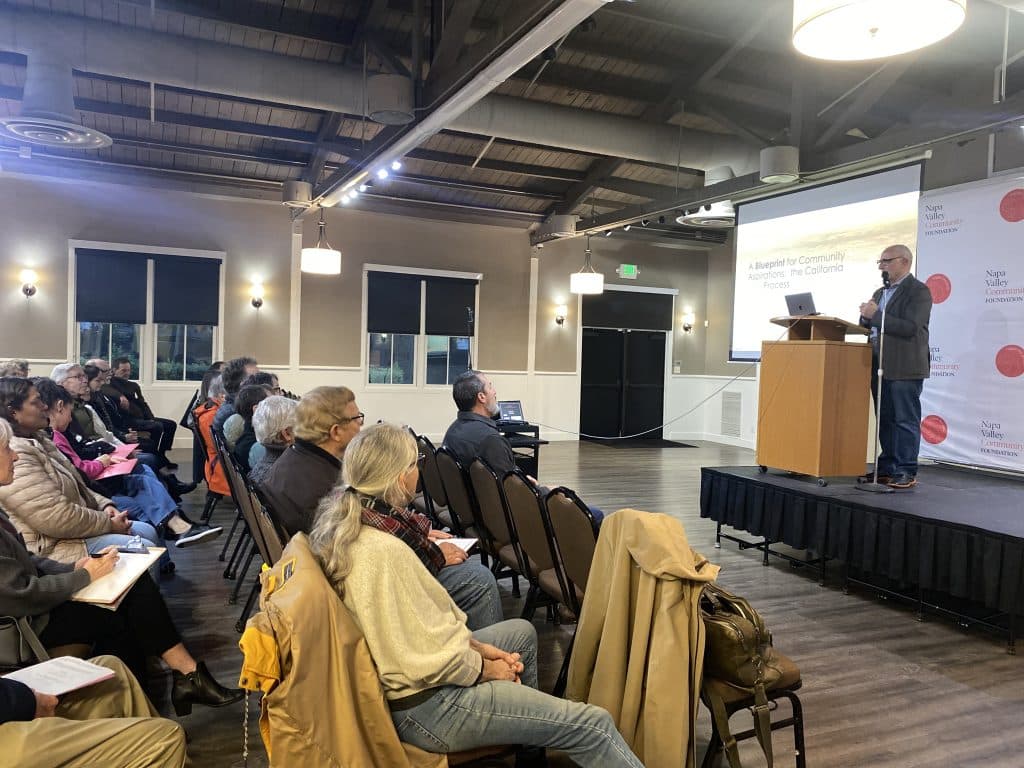
As Napa County prepares to begin the process of updating its General Plan, the Napa Valley Community Foundation hosted a discussion on Feb. 6 to explain the process.
The county’s General Plan was last revised in the summer of 2008. The forthcoming update, which will be completed in 2026, is an opportunity for residents to become engaged, voice their views and participate in shaping the important document.
About 100 people attended the free event, held at Yountville Community Center where urban planner and designer John Rahaim, who served as San Francisco’s planning director from 2008 to 2020, explained what the General Plan is, why it matters and how residents can get involved.
The county’s General Plan serves as a broad framework for planning the future of Napa County and functions as the official policy statement of the Board of Supervisors to guide the private and public development of the county.
General plans, the California Governor’s Office website explains, are local governments’ blueprints for meeting a community’s long-term vision for the future. Technical advisory documents provide supplemental information about general plan topics in response to local needs around the state or changes in state law.
Some of the policies Napa County’s existing General Plan include:
- Directing housing and commercial enterprises.
- Protecting agriculture, watershed, and open space lands by maintaining 40 and 160-acre minimum parcel sizes.
- Limiting uses allowed in agricultural areas and designating agriculture as the primary land use.
- Providing for additional workforce and affordable housing by identifying necessary sites and programs and by continued collaborations with municipalities.
According to the county website, “The first Napa County General Plan was adopted in 1969. Since then, the General Plan has been periodically reviewed and updated to reflect changing conditions and to remain timely and useful. The County adopted a major update to the General Plan in 1983, but it was not until 2005 that another comprehensive update to the General Plan was begun.”
Rahaim explained how planning happens through public policy, zoning and other governmental policies, and by working with the private sector, which can determine what is built and where. The vast majority of what gets built in the United States, he said, is built by the private sector.
Through the plan, the county can determine where something can be built and whether it abides by the codes or general rules on infrastructure and historic preservation. One of the ways to update a general plan, Rahaim said, is to gather data during the first phase of the project.
“There are a number of communities that have a health component element of their general plan,” he said. “It’s not required by the state, but it makes sense for some communities to do that as well. There is, interestingly enough, the most recent requirement of the state… something called an environmental justice component, which has to do with the historic issue of city facilities being located in communities of color and low-income communities of color.”
Rahaim also explained it is far more than the physical environment that affects the character of neighborhoods. It is important, he said, to think about where housing should be built and how it should be built in order to retain the character of a city or county.
In 1968, Napa County established the Agricultural Preserve, or land-zoning ordinance to preserve and maintain the use of land for agricultural purposes and to protect from overdevelopment. Currently, it protects more than 30,000 acres of land. Finding best ways to develop around the Ag Preserve, Rahaim said, can be a challenge.
Another factor when updating general plans, he said, is keeping in mind the jurisdiction’s housing elements, or state-mandated analysis, and plans updated every eight years to identify and meet a community’s housing needs across income levels.
“One of the interesting things about the housing element that didn’t used to exist is that it has to specifically identify locations where housing growth will happen and it has to be within to accommodate the growth that the state has advocated for each county of the state,” he said.
According to Rahaim, community involvement is necessary to create a city’s general plan.
“What kind of place do we want to be?” Rahaim asked. “It’s not just the number of people, but how you engage a diverse cross section of the community. That is really important, and it’s not easy and it takes a lot of work and a lot of time.”
He added, “Some people are not comfortable coming to a meeting like this and asking a question. They might do it through email or through social media or through other means. It’s important to use that whole range of techniques, techniques to engage people.”
Tammy Smith, a Napa County resident who is on the Napa Valley Community Housing board of directors, attended the meeting.
“I learned a lot,” she said, following the meeting. “I think he just confirmed to us that we need to have as many citizens involved in the process as possible. We have a lot of moving parts here in the Napa Valley, so it’s going to be important that we include as many people as possible. He gave us some great ideas about how that can work.”
Julia Smith also attended the meeting and said she would like to see the next General Plan to incorporate better community housing for residents who live and who work in the county so that they can enjoy living locally without having to deal with long commutes and clogged roadways.
According to an official county report, public workshops, online engagement platforms, and community surveys will be available for residents to provide input beginning this spring.
A process to receive input is being developed. A website will be created to let the community know how to be involved. Napa County spokesperson Holly Dawson said the county wants “as much community engagement as possible.”
Once the website is live, she added, the county will share the information with the community and the Chamber of Commerce and will post links to access the website on social media.