Turning down the heat: The hidden power of soil, water and trees in a warming Napa Valley
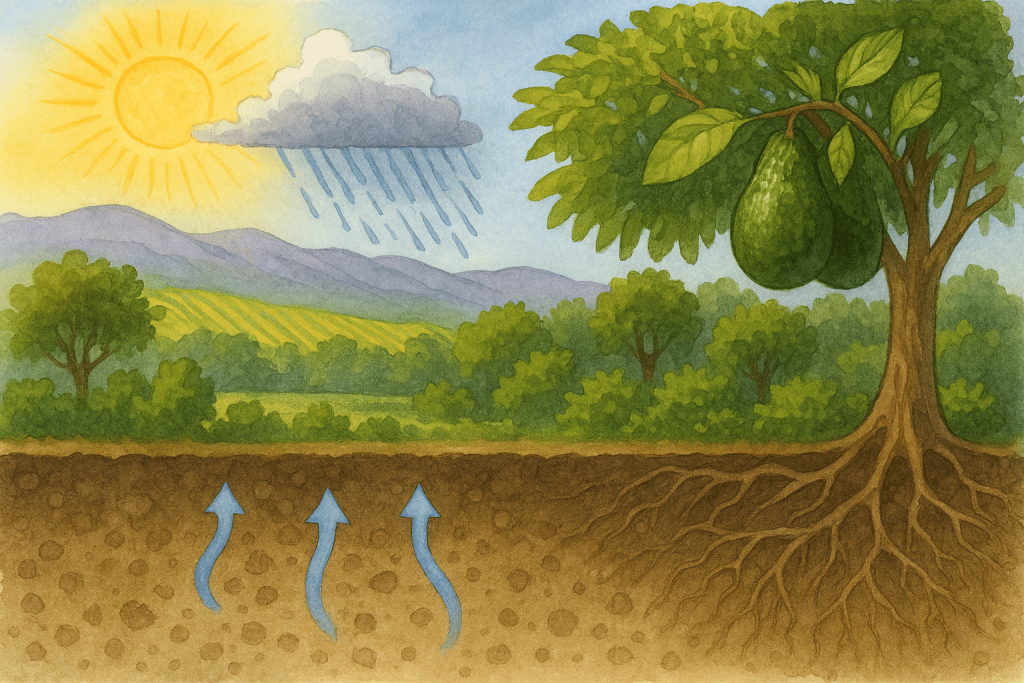
What is the connection between water, soil and a warming climate? Many local gardeners have noticed that we can now grow plants in our yards that did not survive winters on the valley floor 20 years ago.
Our climate has warmed to such an extent that the USDA updated its climate zones a few years ago and has changed Napa Valley to climate zone 9b from 9a. The USDA climate zones reflect the average minimum temperature in every region of the U.S., which is helpful to know if you want to grow avocados in Napa County. You can now do so with a few varieties, such as Mexico Grande and Bacon. They can survive not only in hillside sites but also, with low risk, on the valley floor, where cold air tends to settle.
The obvious reason for this increase in average minimum temperature is a warming climate. There are two ways to combat the warming. One way is to restore the carbon dioxide balance on our planet. The second way is to restore the small water cycle. After all, water vapor is 95 percent responsible for how hot it gets under the thickening blanket of carbon dioxide.
We can turn the heat down by supporting the small water cycle—the constant movement of water from the land to the atmosphere through evaporation and transpiration, and then back to the land when it rains. With vegetation in healthy, spongy soil, that rainwater gets recycled.
As you walk from Napa’s Oxbow Commons to Fuller Park, notice how much cooler the air is in the park and adjacent streets than it was when you were walking along asphalt surfaces along the way. When rain sinks into the soil, it promotes life. Plants thrive in moist soil, recycling water through photosynthesis and transpiration.
Plants act as natural air conditioners. The more trees and shrubs cover open spaces, the cooler the air. Botanical gardens, parks and areas dense with vegetation can reduce the air temperature by as much as 9.5°F.
Many cities in countries far less wealthy than the U.S. are regreening their urban landscapes, while only a few cities closer to home have made headlines with their strategies to reduce so-called “heat islands.”
In 2025, an estimated 150 people experienced heat-related death in the U.S. If Medellín, Columbia, can reduce temperatures throughout the city by 32°F, why can’t we?
Most old-style urban planners, engineers and industrial farmers treat water as a nuisance. They view at as something to move away from settlements and fields as fast as possible via ditches and by turning rivers into concrete channels that divert water.
In our current city landscapes, including Napa, more than 60 percent of the ground is impervious, meaning rain can’t sink in. Instead, it flows into the Napa River and from there to San Pablo Bay and the Pacific Ocean rather than being captured by the soil.
Due to the Napa River Flood Management Plan and the community’s restoration efforts, salmon can again migrate all the way to the headwaters north of Calistoga. Vegetation and wetlands along large stretches of the Napa River have been restored.
The cumulative acreage of impervious urban surfaces that channel water quickly into the bay is substantial. People with an average-sized urban lot can do a lot to keep water on their property and increase soil and vegetation health.
When I had to remove a large Sierra redwood tree that had been planted in the 1970s too close to my home and neighbors’ houses, the stump rotted. I was able to use the wood as mulch. The large hole where the root system penetrated a dense clay layer about two feet below the surface, with its root channels still intact, became a “dry well.” During the rainy season, downspouts on my home channel water from about 800 square feet of roof into the well.
Most areas in the southern reaches of the Napa River have heavy soils and drain slowly. Over centuries, tributaries flowing from the steep hillsides onto the valley floor have dropped their fine sediment as their flow rate decreased, depositing layers of clay.
It’s relatively easy to find out how deep these dense clay layers are and dig through them to enable rain to infiltrate. This way, the soil may become a large water-storage device that keeps vegetation happy through most of the dry season without excessive irrigation.
I water my citrus trees deeply only when heat waves are predicted. For more detailed information about retaining the rain, please visit the Napa County UC Master Gardener website and look for a recording of a recent public workshop on this subject.
Workshop: Join UC Master Gardeners of Napa County for a workshop on “Winter Rose Care” on Saturday, Jan. 10, from 10 a.m. to noon, via Zoom. The workshop will highlight pruning techniques for all rose types, along with everything needed to make your roses a success. Reserve here to receive the Zoom link.
Workshop: Join UC Master Gardeners of Napa County for a workshop on “Starting Your Own Vegetable Seedlings” on Saturday, Jan. 10, from 2 to 4 p.m., at UC Cooperative Extension, 1710 Soscol Avenue, Napa. We’ll cover all the basics, including proper moisture, temperature and light for successful seed starting, and care of seedlings until they are ready for transplant. We provide some seeds, containers and soil; bring your own seeds if you like. Reserve here.
Help Desk: The Master Gardener Help Desk is available to answer your garden questions on Mondays and Fridays from 10 am until 1 pm at the University of California Cooperative Extension Office, 1710 Soscol Avenue, Suite 4, Napa. Or send your questions to [email protected]. Include your name, address, phone number and a brief description of the problem.